
Entry-Level Healthcare Resume Guide (2026)

Healthcare is one of the world's fastest-growing sectors — but landing your first role is fiercely competitive. Whether you're a nursing graduate, a medical administration student, or a healthcare assistant starting out, your resume is the single most important document between you and an interview. This guide walks you through exactly how to write a healthcare resume for entry-level positions that gets past ATS filters and impresses hiring managers in 2026.
The challenge every entry-level healthcare candidate faces is the same: limited formal work history competing against candidates who already have it. The solution isn't to fabricate experience — it's to reframe what you already have in a language healthcare recruiters understand and respect.
Below you'll find a section-by-section breakdown, an ATS keyword guide, a soft skills framework, real before-and-after examples, and a free Healthcare Resume Bundle you can download and use today.
Why Healthcare Resumes Require a Specific Approach
Writing a healthcare resume is not the same as writing a general professional resume. Healthcare employers look for a very specific combination of clinical competency, patient-centred values, regulatory compliance awareness, and professional demeanour — even at entry level.
Here's what makes healthcare hiring unique:
- Certifications are mandatory screening criteria. Missing a required credential (CPR, BLS, HIPAA training) from your resume can result in automatic disqualification — even if you hold it.
- ATS systems are heavily used. Major hospital networks and aged care groups process thousands of applications using ATS software. A resume not optimised for keyword scanning will never reach a human reviewer.
- Soft skills carry unusual weight. Empathy, composure under pressure, and communication are not nice-to-haves in healthcare — they're clinical tools. Recruiters actively screen for evidence of them.
- Regulated roles have compliance requirements. Even entry-level roles may require references to licensing bodies, scope-of-practice statements, or police clearance acknowledgements.
The 6 Essential Sections of an Entry-Level Healthcare Resume
A well-structured healthcare resume includes six key sections, presented in a specific order that mirrors how recruiters review applications. Here's the complete framework:
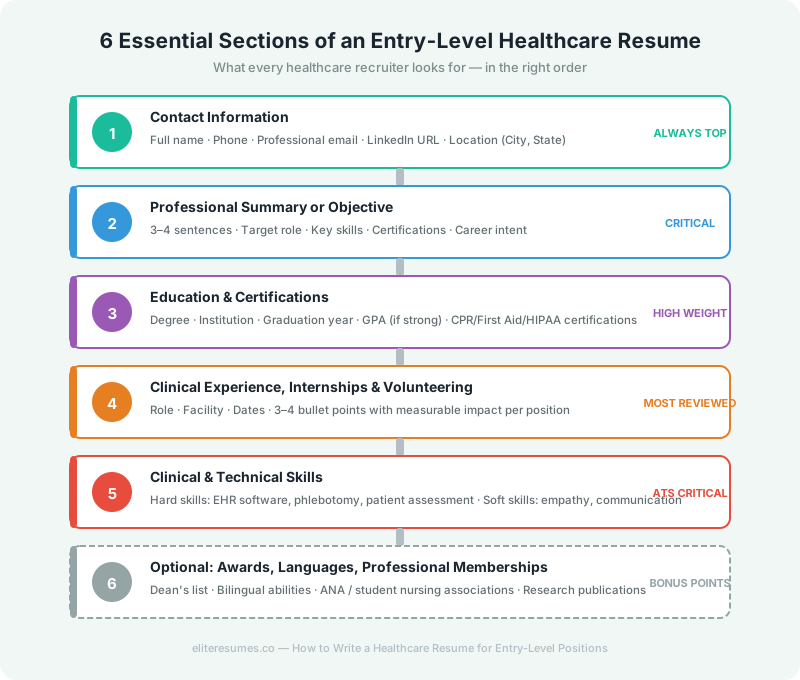
The six sections every healthcare recruiter expects to see — in this order
Section 1: Contact Information
Place this at the very top. Include your full name, professional email address (firstname.lastname@email.com format), phone number, LinkedIn URL, and your city and state/country. Do not include a full street address — this is outdated and takes up valuable space. If you hold a current nursing licence or registration number, include it here or directly below your name.
Section 2: Professional Summary or Objective
For entry-level healthcare candidates, a well-crafted career objective is often more effective than a summary, as it frames your ambition and direction rather than overstating experience you don't yet have. Keep it to 3–4 focused sentences. Include your degree or qualification, one or two core clinical skills, a relevant certification, and the type of role you're targeting.
Example objective:
For a detailed breakdown of when to use an objective versus a summary, see our guide on Resume Objective vs Summary.
Section 3: Education & Certifications
In healthcare, education section placement is critical. If you're a recent graduate, your degree is your primary credential — list it prominently, before your experience section. Include your degree name, institution, graduation year, and GPA if it's a distinction average or higher. Below your degree, list all professional certifications with their expiry dates if applicable.
Essential certifications to list (if held):
- CPR / AED Certification
- Basic Life Support (BLS)
- First Aid Certificate
- HIPAA Compliance Training
- Phlebotomy Certification
- Certified Nursing Assistant (CNA), Medical Assistant (MA), or Patient Care Technician (PCT)
For formatting guidance, see our Resume Education Section guide.
Section 4: Clinical Experience, Internships & Volunteering
This is the section recruiters spend the most time reading. For entry-level candidates, this typically includes clinical placements, supervised rotations, volunteer positions at hospitals or clinics, and any part-time or casual healthcare support work. List each position in reverse chronological order with:
- Job title / role
- Facility / organisation name
- Location (City, State)
- Date range (Month Year – Month Year)
- 3–4 bullet points describing your responsibilities and impact
Quantify wherever possible: "Assisted with patient care across a 20-bed acute ward" is far stronger than "helped with patient care." Numbers signal competence and provide context that generic statements can't. Even approximate figures are powerful.
Section 5: Clinical & Technical Skills
Healthcare resumes need a clearly delineated skills section because ATS systems are programmed to scan for specific clinical terminology. Divide your skills into two columns: Clinical/Technical Skills and Soft Skills. Keep each item concise — the skills section is scanned, not read in detail. For a comprehensive approach, see our Resume Skills Section guide.
Section 6: Optional Additions
If space allows and they're genuinely relevant, include: academic awards or distinctions, languages spoken (highly valued in multicultural healthcare settings), professional memberships (student nursing associations, allied health bodies), or published research or presentations.
Writing Powerful Bullet Points: Before & After Examples
The single most impactful upgrade you can make to an entry-level healthcare resume is transforming weak, passive bullet points into strong, evidence-based ones. Here are real examples:
"Helped nurses with patient care tasks during placement."
"Assisted registered nurses in monitoring and documenting vital signs for 15+ patients daily across a 24-bed medical ward during 160-hour acute care placement."
"Did some administrative work at a medical centre."
"Managed patient scheduling and appointment reminders for a 4-GP practice, reducing no-show rates by approximately 18% over a 3-month volunteer placement."
"Good communication skills and worked well in a team."
"Collaborated daily with a multidisciplinary team of nurses, physiotherapists, and social workers to deliver coordinated discharge planning for post-surgical patients."
For more high-impact language, browse our full list of Resume Action Verbs used by healthcare professionals.
ATS Optimisation for Healthcare Resumes
Most healthcare employers — hospitals, aged care networks, medical centres, and allied health groups — use Applicant Tracking Systems to filter incoming applications. Understanding how ATS works is not optional for job seekers in 2026; it's a baseline requirement.
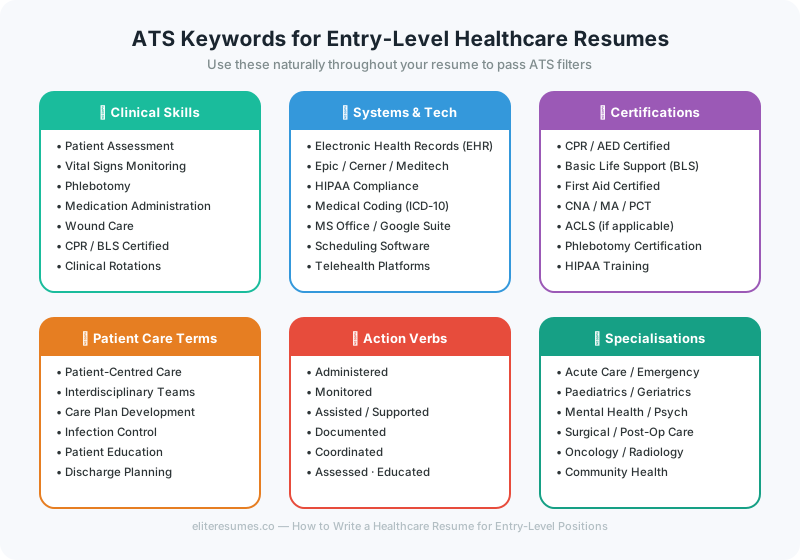
Use these keyword categories to build an ATS-optimised healthcare resume
How to Use ATS Keywords Correctly
Mirror the job description language exactly
If the posting says "Electronic Health Records (EHR)" — use that exact phrase. Don't substitute "digital patient files" even if it means the same thing. ATS searches for literal matches.
Include both spelled-out terms and abbreviations
Write "Basic Life Support (BLS)" the first time — some ATS systems search for the abbreviation, others for the full term. One mention covers both.
Don't stuff keywords unnaturally
ATS keyword density matters, but modern systems also flag unnatural usage. Weave terms into bullet points and your summary naturally, not as a standalone keyword list hidden in white text.
Use a clean, single-column layout
Tables, text boxes, columns, headers/footers, and graphics confuse ATS parsers. Stick to a single-column structure with standard section headings (Work Experience, Education, Skills).
Submit as PDF unless Word is specified
Modern ATS systems handle PDFs reliably. PDF preserves your formatting across devices and prevents accidental edits. Only submit a .docx if the employer explicitly requires it.
Run your completed resume through our ATS Resume Checklist before submitting to any healthcare role. You can also learn how to bypass ATS filters with a tailored optimisation strategy.
Soft Skills Healthcare Employers Actually Screen For
In healthcare, soft skills are not "soft" at all — they're clinical safety requirements. A nurse who can't communicate clearly under pressure is a patient safety risk. An administrator who lacks empathy damages patient experience scores. Healthcare employers know this, and they look for evidence of these skills at every level of hiring.
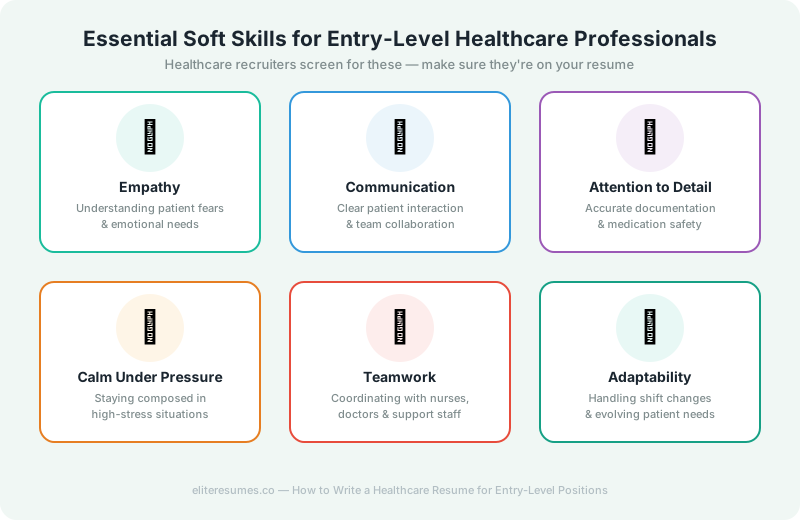
Six soft skills healthcare recruiters look for in every entry-level candidate
How to Evidence Soft Skills on Your Resume
Don't just list "empathy" or "communication" in your skills section — every candidate does this. Instead, prove them through your bullet points:
- Empathy: "Provided emotional support to patients and families in end-of-life care settings during 80-hour palliative care rotation."
- Communication: "Delivered daily handover reports to oncoming nursing staff, maintaining 100% accuracy in patient status documentation."
- Calm under pressure: "Remained composed and followed emergency protocols during two cardiac event responses in the ED, assisting senior staff with code blue procedures."
- Teamwork: "Collaborated with physiotherapy, social work, and dietary teams to implement tailored patient care plans for 12 post-surgical patients simultaneously."
- Attention to detail: "Administered medications under supervision with zero documentation errors across 200+ patient interactions throughout clinical placement."
Tailoring Your Resume for Specific Healthcare Roles
The healthcare sector is broad. A resume targeting a Registered Nurse position at an acute hospital should read very differently from one targeting a Medical Receptionist role or an Allied Health Assistant position. Here's how to tailor effectively by role type:
Nursing (RN, EN, AIN)
Lead with your nursing registration or upcoming graduation date. Emphasise clinical placement hours, patient-to-nurse ratios you've worked in, and any specialty rotations (ED, ICU, maternity, paediatrics). Reference specific clinical skills: medication administration, IV cannulation, wound assessment, documentation in electronic systems.
Medical Administration & Healthcare Coordination
Highlight scheduling systems, patient communication, billing software experience, and your understanding of medical terminology. If you've handled Medicare/insurance billing, private health claims, or referral management — name those systems explicitly. AHPRA registration verification processes and practice software (Best Practice, Medical Director, Cliniko) are strong differentiators.
Allied Health (Physiotherapy, OT, Dietetics, Pharmacy)
These roles demand evidence of supervised placement hours and specific clinical assessment tools used in your discipline. Include professional body memberships (AHPA, Dietitians Australia, PSA) and any relevant software (Helix, AutoCAD for OT, FRED Dispense for pharmacy).
Aged Care & Disability Support
Person-centred care language is essential here. Reference NDIS quality standards, manual handling training, dementia care competencies, and medication assistance certificates. Cultural competency and experience supporting CALD (Culturally and Linguistically Diverse) communities is increasingly valued.
One resume per application: Save a "master" version and create a tailored copy for each role. Spending 20 extra minutes on customisation per application consistently produces better results than mass-sending a generic document. Our no-experience resume guide covers this customisation approach in detail.
Free Download: Elite Resumes Healthcare Bundle
Get our complete Healthcare Resume Bundle — designed specifically for entry-level and graduate healthcare candidates. Everything you need to create a standout, ATS-ready application from day one.
- ✅ ATS-optimised healthcare resume templates
- ✅ Cover letter templates for nursing, allied health & admin roles
- ✅ Healthcare keyword checklist by specialty
- ✅ Clinical experience bullet point bank
- ✅ Certification & credentials formatting guide
Common Mistakes to Avoid in Your Healthcare Resume
1. Omitting Certifications That Are Standard
CPR, BLS, and First Aid certifications are so common in healthcare that some candidates assume they don't need to be listed. They do. ATS systems and human reviewers both check for them. If yours are expired, renew them before applying — an expired CPR cert raises immediate concerns.
2. Using a Photograph
In Australia, the UK, the US, and most English-speaking markets, including a photo on your resume is inappropriate and can actually trigger unconscious bias concerns that disqualify your application. Keep photos off your resume in these markets entirely.
3. Generic Objective Statements
"I am a hardworking and dedicated individual looking for a healthcare role" tells a recruiter nothing. Your objective or summary must reference the specific role type, your qualification, and one or two concrete skills. Generic statements signal a mass-application approach — the opposite of what healthcare employers want to see.
4. Listing Duties Instead of Achievements
A duty is what your role required you to do. An achievement is what you actually did and what resulted from it. "Responsible for patient documentation" is a duty. "Maintained accurate EHR records for 25+ daily patient encounters with zero discrepancies flagged in supervisor review" is an achievement. The distinction is what separates shortlisted candidates from rejected ones.
5. Using the Wrong File Format or Font
Decorative fonts, coloured backgrounds, and creative infographic-style templates may look impressive but perform poorly in ATS parsing. Use clean, standard fonts (Calibri, Arial, or Garamond), standard section headings, and save as PDF. Your resume should be beautiful and ATS-safe — these goals are not mutually exclusive when formatted correctly.
6. Neglecting a LinkedIn Profile
Healthcare recruiters increasingly cross-reference LinkedIn when reviewing applications. If your profile is empty, incomplete, or inconsistent with your resume, it damages credibility. Ensure your LinkedIn summary reinforces your resume narrative and that your experience dates match exactly. Our guide to improving LinkedIn visibility for job seekers covers this in detail.
Frequently Asked Questions
Ready to Build a Healthcare Resume That Gets Interviews?
Download our free Healthcare Resume Bundle to get started instantly — or let the experts at Elite Resumes craft your complete application. We know exactly what healthcare hiring managers want to see.