
Resume Tips for Recent Graduates in Australia (2026)
Entering Australia's job market with a fresh degree is exciting — but also fiercely competitive. Recruiters spend an average of 7 seconds scanning a resume, and over 90% of large employers use Applicant Tracking Systems (ATS) before a human ever reads your application. This comprehensive guide covers everything you need: a step-by-step resume framework, a free downloadable template, a government resume sample, a selection criteria guide, an ATS checklist, and a complete resume review offer — all tailored for Australian graduates in 2026.
Why Your Resume Is Your Most Important Job-Search Asset
Australia's graduate job market is one of the most competitive in the Asia-Pacific region. In 2026, graduate unemployment remains elevated in fields like arts, communications, and social sciences, while demand is high in technology, healthcare, engineering, and finance. In every industry, the resume remains the single document that determines whether you get an interview.
A strong graduate resume in Australia must:
- Pass through ATS software used by companies like BHP, ANZ, Woolworths, and the APS (Australian Public Service).
- Highlight transferable skills when direct experience is limited.
- Follow Australian conventions (no photo, no date of birth, concise 1–2 pages).
- Speak directly to the employer's selection criteria.
Step-by-Step Guide to Writing a Graduate Resume in Australia
Step 1: Contact Information
Place this at the very top. Include:
- Full name (larger font, bold)
- Mobile number (Australian format: 04XX XXX XXX)
- Professional email address (firstname.lastname@domain.com)
- LinkedIn profile URL (customise it: linkedin.com/in/yourname)
- City and state only — full address is not necessary
- GitHub or portfolio URL if relevant to your field
Pro Tip: If your email is something like partyanimal99@hotmail.com, create a new professional address before applying for any job. First impressions start before the first word of your resume.
Step 2: Career Objective (for Graduates) or Professional Summary
Recent graduates benefit more from a career objective than a professional summary, since you have limited experience to summarise. A strong career objective is 2–3 sentences that:
- Identify who you are (your degree and area of study)
- State what you want to contribute to the employer
- Highlight your strongest transferable skill or achievement
Example: "Commerce graduate from the University of Melbourne with a major in Marketing and a distinction average. Experienced in data-driven campaign management through a semester-long internship at a Sydney-based digital agency. Seeking a graduate marketing role where I can apply my analytical and creative skills to drive measurable brand growth."
Step 3: Education
For recent graduates, Education comes before Experience. Include:
- Degree name, major, and specialisation
- University name and campus (if multiple)
- Graduation year (or expected graduation)
- GPA or WAM — only if it's 65+ or above average
- Academic awards, scholarships, or Dean's List recognition
- Relevant subjects (optional, keep to 3–5 maximum)
Step 4: Work Experience (Including Internships & Part-Time)
List in reverse-chronological order. For each role include:
- Job title, employer name, city, and date range (Month Year – Month Year)
- 3–5 bullet points using action verb + task + result structure
- Quantified achievements wherever possible (e.g., "Increased social media engagement by 40%")
Step 5: Skills
Create two subsections: Technical Skills and Soft Skills. Tailor this to each job ad. Include only skills you can speak to confidently in an interview.
Step 6: Extracurricular Activities & Volunteer Work
Australian employers genuinely value community involvement. If you have held a leadership role in a club, participated in a hackathon, organised a charity event, or volunteered regularly, include it. These experiences demonstrate initiative, teamwork, and character — qualities that set you apart when two candidates have similar academic records.
Step 7: Referees
Do not list referee contact details on your resume. Write: "Professional references available upon request." Prepare a separate reference sheet with 2–3 contacts (academic supervisors, internship managers) to bring to interviews.
Australian Resume Formats Explained
There are three resume formats used in Australia. Understanding which to use for your situation will give you a significant advantage:
| Format | Best For | Structure | Graduate Suitability |
|---|---|---|---|
| Reverse-Chronological | Most graduates, any industry | Experience listed newest first | ✓ Highly recommended |
| Functional | Career changers, gaps in history | Skills grouped by category | ⚠ Use with caution — ATS-unfriendly |
| Combination | Mixed experience backgrounds | Skills summary + chronological exp. | ✓ Good if you have diverse roles |
For the vast majority of Australian graduate roles — including Big 4 accounting firms, government agencies, banks, hospitals, and tech companies — the reverse-chronological format is the safest and most effective choice.
Free Download: Australian Graduate Resume Template
We've created an ATS-compatible, professionally designed resume template specifically for recent graduates in the Australian job market. It's formatted for Microsoft Word and Google Docs, uses clean fonts and spacing that pass through ATS scanners, and follows all Australian resume conventions.
⬇ Australian Graduate Resume Template (Free)
A clean, ATS-ready, 1–2 page resume template tailored for Australian graduate applications. Includes a pre-written career objective, skills section, education block, and experience bullet-point prompts. Available in Word and PDF format.
Download Free Template →What NOT to Include in Your Australian Resume
Unlike resumes in some other countries, Australian resumes have specific conventions about what to exclude. Including the wrong information can actually hurt your application or flag unconscious bias concerns for hiring managers trained in EEO (Equal Employment Opportunity) practices.
- Photo or headshot (never include unless you're applying for modelling or acting roles)
- Date of birth or age
- Marital status, nationality, or religion
- TFN (Tax File Number) or personal ID numbers
- Hobbies that are irrelevant (e.g., "I enjoy watching Netflix")
- References listed with contact details (use a separate reference sheet)
- Reasons for leaving previous jobs
- Salary expectations (unless specifically requested)
- High school results (if you're a university graduate)
Government Jobs: What's Different & How to Apply
Australian Public Service (APS) roles — including positions at the Australian Tax Office, NDIS, Services Australia, and state government departments — have a fundamentally different application process compared to private sector jobs. Understanding this difference is essential if you want to work in government.
Key Differences in Government Resume Applications
| Feature | Private Sector | Australian Government |
|---|---|---|
| Resume Length | 1–2 pages | 2–3 pages acceptable |
| Selection Criteria | Usually informal or implied | Explicit, mandatory written responses |
| Cover Letter | 1 page general | Addresses role-specific criteria |
| Referees | Available on request | Often required upfront |
| APS Capability Framework | Not required | Highly recommended to reference |
| Language | Results-focused, commercial | Policy-aware, stakeholder-focused |
⬇ Sample Government Resume for Australian Graduates
Download our annotated sample APS-ready resume for recent graduates applying to entry-level positions (APS Level 3–5). Includes a real-world example of how to structure experience, skills, and capability statements using APS language and the Integrated Leadership System (ILS) framework.
Download Government Resume Sample →APS Tip: Use the Australian Public Service Commission's Capability Framework when writing your government resume. Phrases like "supports shared outcomes," "builds productive relationships," and "applies critical thinking" resonate strongly with APS selection panels.
How to Address Selection Criteria Using the STAR Method
Many Australian employers — particularly government agencies, universities, hospitals, and large corporations — require applicants to address specific selection criteria in a separate written document or within the cover letter. Failing to do so correctly is one of the most common reasons graduates are rejected without interview.

The STAR Method Explained
- S – Situation: Describe the background and context. Keep this brief (1–2 sentences).
- T – Task: Explain your specific responsibility or challenge in that situation.
- A – Action: Detail the specific steps you took. Use "I" — not "we" — to show individual accountability.
- R – Result: Quantify the outcome wherever possible. What changed? What improved? By how much?
Target length: 150–300 words per criterion. Format: Flowing paragraphs (not bullet points) unless otherwise specified by the employer.
STAR Example for "Ability to Work in a Team"
⬇ Selection Criteria Response Guide (Free Download)
Our 12-page guide covers the most common Australian selection criteria, with STAR examples for each one — including "ability to communicate effectively," "stakeholder management," "commitment to diversity," and more. Includes a fill-in-the-blank STAR template.
Download Selection Criteria Guide →ATS Optimisation: Getting Past the Robots
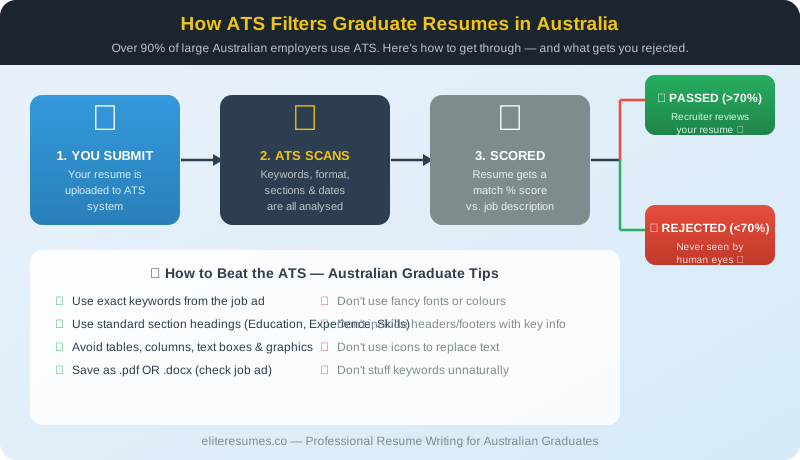
Over 90% of large Australian employers use Applicant Tracking Systems to filter applications before a human reads them. Understanding how ATS works — and how to beat it — is not optional for 2026 job seekers.
How to Optimise Your Resume for Australian ATS Systems
- Mirror the job ad's language: If the ad says "stakeholder engagement," use that exact phrase — not "client relations."
- Use standard section headings: "Work Experience," "Education," "Skills" — not creative alternatives like "My Journey" or "Where I've Been."
- Avoid tables and columns: Many ATS systems read left to right and cannot parse multi-column layouts.
- No text boxes or graphics: ATS software cannot read text inside shapes, graphics, or headers/footers.
- File format: Unless specified, submit as PDF. If the ATS specifically requests Word (.docx), use that.
- Spell out acronyms: Write "Applicant Tracking System (ATS)" rather than just "ATS" on first use.
Keyword Tip: Paste the job description into a free word cloud tool (e.g., WordArt.com). The largest words are the ATS keywords the employer cares about most. Make sure these appear naturally in your resume — particularly in your objective, experience bullets, and skills section. For a full list, see our ATS Keywords guide.
Complete Resume Checklist for Australian Graduates 2026
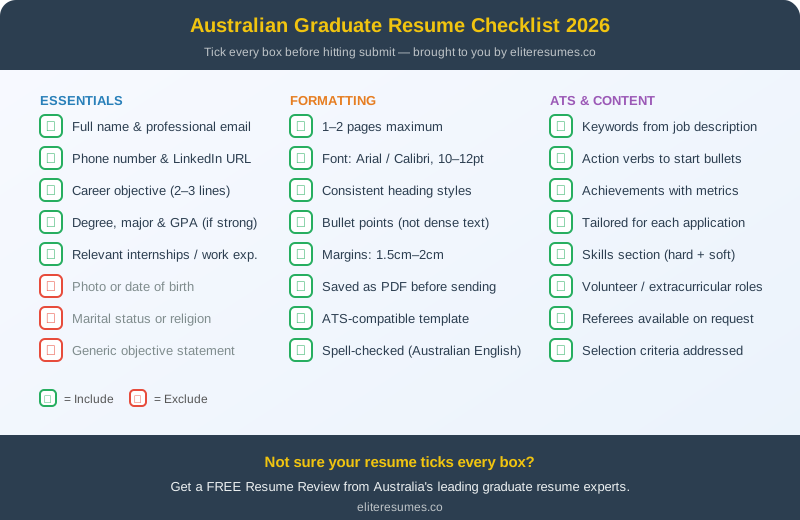
Before submitting any application, run through this checklist. If you can't tick every box in the "include" list, revise your resume first.
⬇ Printable Resume Checklist (PDF)
Download our printable one-page checklist covering essentials, formatting, content, and ATS requirements for Australian graduate resumes. Keep it next to you every time you apply for a job.
Download Resume Checklist →Common Resume Mistakes Australian Graduates Make
- Using a generic resume for every application. Tailoring your resume to each job ad is the single highest-impact change you can make. Even minor tweaks to your objective and skills section significantly boost your match rate.
- Listing responsibilities instead of achievements. "Responsible for social media" says nothing. "Grew Instagram following by 2,300 in 4 months through targeted content strategy" is what gets interviews.
- Spelling and grammar errors. In competitive graduate markets, a single typo can disqualify you. Use Australian English (e.g., "organisation," not "organization").
- Using an unreadable or overly designed template. Creative templates with icons, charts, and graphics look impressive to the eye but are often invisible to ATS software.
- Ignoring selection criteria. If a role requires you to address selection criteria and you don't — your application is automatically disqualified, regardless of how strong your resume is.
- Not customising the LinkedIn URL. Your default LinkedIn URL contains random numbers. Go to Settings > Edit Public Profile and set a clean URL like linkedin.com/in/yourname.
- Claiming skills you can't demonstrate. If "Advanced Excel" is on your resume, be ready to pivot tables and write VLOOKUP formulas in an interview.
Frequently Asked Questions
Get Your Resume Reviewed — For Free
Not sure if your resume will make it past the ATS? Not getting callbacks despite applying to dozens of roles? Elite Resumes offers a free, no-obligation resume review by a certified Australian resume writer. We'll assess your ATS score, keyword density, formatting, and overall impact — and give you a personalised action plan within 48 hours.