
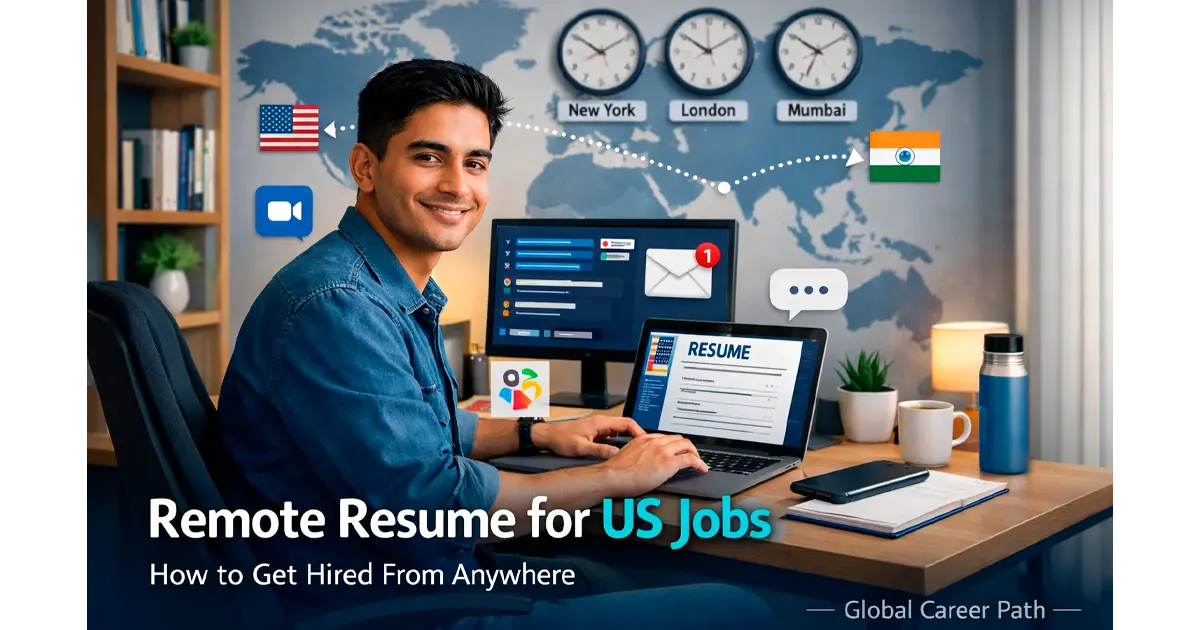
I spent three years hiring remote employees for a distributed US company. We had team members in fourteen countries, from Brazil to the Philippines to Poland. And I learned something that might surprise you: the candidates who got hired weren't always the most technically skilled.
They were the ones who understood what remote actually means.
The Uncomfortable Truth About Remote Work
When a US company posts a remote role open to international candidates, they're taking a risk. They can't see you working. They can't walk by your desk. They're trusting you to deliver results across time zones, cultural differences, and the thousand small frictions that come with distributed work.
Your resume's job is to eliminate that perceived risk.
Most international candidates make the same mistake. They apply with a resume optimized for local in-office roles, maybe add "open to remote work" somewhere, and wonder why they never hear back. They're competing against candidates who've spent years building a remote-first professional identity—and it shows.
Why US Companies Hire Remote International Talent
Before we optimize your resume, you need to understand what's happening on the other side of the hiring table.
US companies hiring internationally are usually motivated by one of three things: accessing specialized talent they can't find domestically, extending their coverage hours across time zones, or managing costs while maintaining quality.
The hiring manager is asking themselves: Will this person be able to collaborate effectively with a team they'll never meet in person? Will they communicate clearly when there's no chance for hallway conversations? Will they manage their time and deliverables without constant oversight? Will the time zone difference create friction or solve problems?
Your resume needs to answer these questions before they're asked.
The Professional Summary: Establishing Remote-First Identity
Your professional summary is prime real estate. Most candidates waste it on generic statements about being "passionate" or "results-driven." For a remote role, you need to establish three things immediately: your core expertise, your remote work track record, and your specific value proposition for distributed teams.
❌ Generic Summary
"Experienced software developer with 6 years of experience in full-stack development. Proficient in React, Node.js, and Python. Looking for challenging opportunities to grow my career."
✅ Remote-Optimized Summary
"Full-stack developer with 6 years of experience delivering products for US-based distributed teams. Currently collaborating across 4 time zones with a Series B startup, maintaining 98% async communication with 4-hour daily EST overlap. Specialized in React and Node.js with a track record of shipping independently while keeping stakeholders aligned through detailed documentation and proactive updates."
The second version answers the hiring manager's unspoken questions. Can you work across time zones? Proven. Can you communicate asynchronously? Yes, and here's how. Can you ship without constant oversight? Track record of it.
Time Zone Management: Your Secret Weapon
Time zone management isn't just logistics. For US companies, it's a make-or-break factor.
I've seen qualified candidates rejected because their resume made the hiring manager do math. The moment you force a hiring manager to think about complications, you've lost momentum. Your resume should make time zone overlap feel easy and solved.
How to Present Time Zone Availability
Create a dedicated line in your header or summary that explicitly states your overlap. Be specific. Be generous. Frame it in their time zone, not yours.
Examples of Clear Time Zone Statements:
- "Available 6 AM – 12 PM EST daily for synchronous collaboration (full morning overlap with US East Coast)"
- "Core working hours flexible to accommodate 4+ hours daily overlap with PST teams"
- "Currently maintaining 9 AM – 1 PM EST overlap; open to adjusting schedule for team needs"
These statements don't just mention time zones—they solve the problem proactively. They tell the hiring manager "I've already figured this out. You don't need to worry about it."
Time Zone as Competitive Advantage
Depending on where you're located, your time zone might actually be an advantage:
- Eastern Europe: Overlap with both US East Coast mornings and European business hours—valuable for transatlantic teams
- Latin America: Nearly the same time zones as the US—a massive competitive advantage
- India/Southeast Asia: Provide coverage during US overnight hours—critical for 24/7 operations
Remote Tools: Proving Fluency, Not Just Familiarity
Every candidate lists tools on their resume. "Proficient in Microsoft Office" tells a hiring manager nothing. For remote roles, you need to demonstrate that you've used remote tools to collaborate effectively across distances.
The Tools That Matter Most
How to Present Tool Proficiency
❌ Weak Presentation
"Tools: Slack, Zoom, Jira, Notion, GitHub"
✅ Strong Presentation
Remote Collaboration Stack:
- Slack: Primary async communication across 3 time zones; response time under 4 hours
- Notion: Built 50+ documentation pages; reduced onboarding by 40%
- Loom: Created 100+ async video updates; eliminated 80% of status meetings
- Jira: Managed sprint planning for distributed team of 8 engineers
- GitHub: 500+ pull requests with detailed async code reviews
This tells a story. It shows you don't just have accounts on these platforms—you've used them to solve the specific problems that remote work creates.
Async Communication: Your Most Valuable Skill
Asynchronous communication is critical for distributed teams. US companies live and die by async communication. The ability to write clearly, document thoroughly, and communicate without real-time back-and-forth is often more valuable than technical skills.
Highlight Async Communication Achievements:
- Wrote weekly async standups that reduced team sync meetings from 5 hours to 1 hour weekly
- Documented all technical decisions in searchable wiki, eliminating call requirements across time zones
- Developed async feedback protocol for design reviews, reducing review cycle time by 60%
- Created Loom video library for common processes, eliminating 90% of repetitive explanations
Showcasing Remote Readiness Through Experience
The most powerful evidence of remote work capability is previous remote work experience. If you have it, feature it prominently.
If You Have Remote Work Experience
Don't bury this. Make it visible immediately in your work experience section:
Senior Developer | TechCorp (Fully Remote – US Company)
- Delivered 23 features over 18 months while working fully remotely, maintaining velocity equivalent to on-site teams
- Collaborated daily with teammates in San Francisco, London, and Sydney without in-person meetings
- Promoted twice while fully remote, demonstrating ability to build relationships and prove impact without physical presence
- Managed client relationships entirely via Zoom and async communication, maintaining 94% satisfaction scores
If You Don't Have Traditional Remote Experience
Alternative experiences that demonstrate remote capabilities:
Freelance or Contract Work
Managed 15+ concurrent client relationships across 8 time zones • Delivered 40+ projects with 100% on-time completion
Open Source Contributions
Active contributor collaborating with maintainers across 12 countries • Merged 30+ pull requests through async code review
COVID-Era Remote Work
Transitioned to fully remote March 2020 • Maintained productivity with "exceeds expectations" rating throughout 18-month remote period
Create a Remote Readiness Section
Consider adding a dedicated section that consolidates your remote qualifications:
Remote Work Profile
- 4+ years collaborating with US-based distributed teams
- Reliable high-speed internet (100+ Mbps) with backup power and professional video setup
- Fluent in async-first communication; response time under 3 hours during overlap
- Track record of self-directed work with minimal supervision
- Available 5+ hours daily overlap with US Eastern Time
Reframe Your Experience Section for Remote Value
Your work experience needs different emphasis for remote roles. Highlight not just what you accomplished, but how you accomplished it in ways that translate to distributed work.
Traditional Approach:
"Led development of payment processing system, reducing transaction failures by 45%"
Remote-Optimized Approach:
"Led development of payment processing system across distributed team (US, Poland, Philippines), coordinating async handoffs across 3 time zones, reducing transaction failures by 45%, while maintaining documentation enabling any team member to deploy or debug independently"
Skills Section: Remote-Specific Competencies
Group your skills thoughtfully to highlight remote work capabilities:
Remote Collaboration
Asynchronous communication • Cross-cultural team collaboration • Time zone coordination • Video conferencing • Remote project management
Tools & Platforms
Communication: Slack, Zoom, Loom, Google Meet
Project Management: Jira, Notion, Linear, Asana
Documentation: Confluence, Notion, Google Workspace
Languages
English: Professional fluency (written and verbal)
Address Hiring Manager Concerns Proactively
Understanding what US hiring managers worry about helps you preempt concerns:
Evidence of English proficiency, written communication samples, US team collaboration
Demonstrate self-management, independent projects, delivery without close supervision
Address availability explicitly, show flexibility for critical issues
Mention professional setup, backup options, infrastructure stability
Evidence of cross-cultural collaboration and US business familiarity
Your Cover Letter is an Async Communication Sample
For remote roles, your cover letter demonstrates your written communication skills. A hiring manager reading it thinks: "Is this how they'll write Slack messages? Emails to clients? Documentation?"
Address the remote aspect directly:
"I noticed this role is open to international candidates, and I want to share why I'm particularly well-suited for distributed work. For the past three years, I've collaborated daily with US-based teams from my home office in Bangalore. I've built the infrastructure, habits, and communication skills that remote work demands. I don't just tolerate async work—I thrive in it."
Common Mistakes That Kill Applications
- Vague Availability: "Flexible schedule" means nothing. Be specific: "Available 6 AM – 12 PM EST"
- Hiding Your Location: Be upfront and frame it positively
- Underselling English Proficiency: If you're fluent, say so clearly
- Ignoring Async Reality: Remote work is primarily written communication, not video calls
- Failing to Localize: Use US spelling, dates, and formats (signals cultural fluency)
- No Infrastructure Evidence: Mention professional setup, backup power, and reliable internet
Remote Resume Checklist
- ☐ Professional summary explicitly mentions remote work experience or capability
- ☐ Time zone overlap stated clearly in EST/PST/CST
- ☐ Remote tools listed with evidence of collaborative use
- ☐ Work experience highlights async communication and cross-timezone collaboration
- ☐ Remote/freelance/distributed experience prominently featured
- ☐ English proficiency explicitly stated
- ☐ Skills section includes remote-specific competencies
- ☐ Infrastructure readiness mentioned (reliable internet, professional setup)
- ☐ US spelling and date formats used throughout
- ☐ Cover letter demonstrates strong written communication
The Opportunity is Real
US companies are hiring internationally more than ever. The talent pool has gone global, and smart companies are taking advantage of it. But they're being selective—looking for candidates who understand distributed work, who've prepared for its challenges, and who can contribute from day one.
Your resume is your proof that you're that candidate.
The candidates who get hired for these roles aren't lucky. They're prepared. They've thought about what remote really means, and they've built resumes that answer every question before it's asked.
That can be you.
Ready to Land Your Remote US Role?
Optimizing your resume for remote roles with US companies requires a different approach. If you're serious about working for US companies from India, Eastern Europe, Latin America, or anywhere else in the world, make sure your resume is working as hard as you are.
Not Sure If Your Resume Passes the 'Remote Risk' Test?
Get a free review from the Elite Resumes team and find out exactly how to optimize your resume for US remote positions.
Get Your Free Resume Review