
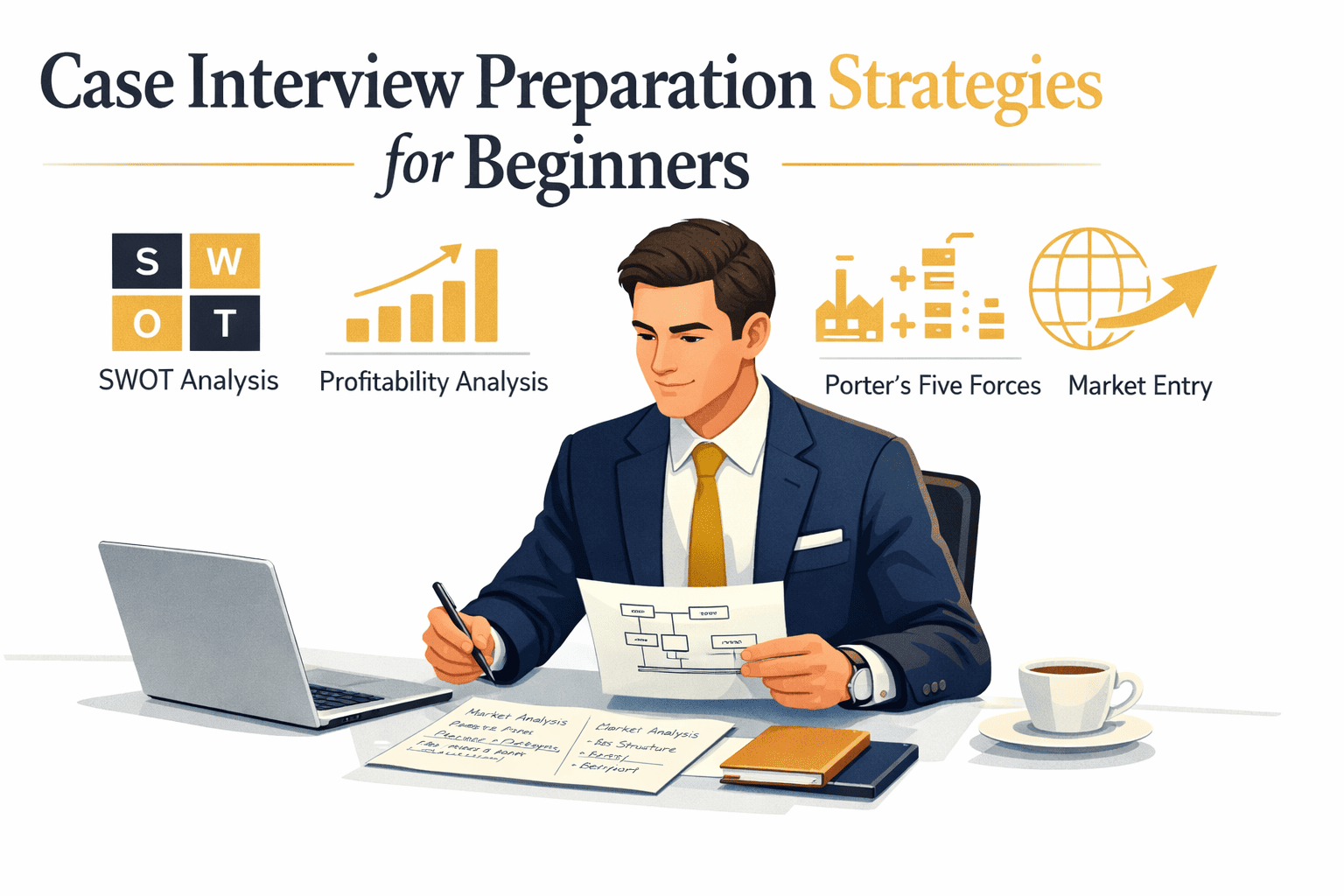
If you're targeting a career at a top consulting firm — McKinsey, BCG, Bain, Deloitte, or any strategy consulting role — the case interview is the biggest hurdle standing between you and an offer. For beginners, it can feel incredibly mysterious. You're asked to "solve a business problem" on the spot, with no data, no time to research, and an interviewer watching your every move.
The good news? Case interviews are learnable. With the right frameworks, deliberate practice, and a structured preparation timeline, thousands of candidates from non-traditional backgrounds crack these interviews every year. This guide gives you everything you need to start — from day one.
What Is a Case Interview?
A case interview is a structured problem-solving exercise where the interviewer presents a real-world business scenario — a company entering a new market, falling profits, a merger decision — and you must work through it live. Unlike behavioural interviews, there is no single right answer. What matters is how you think.
Case interviews are used by top consulting firms precisely because consulting work is ambiguous and fast-paced. Clients need advisors who can structure messy problems quickly, identify key drivers, and communicate clear recommendations — exactly what the case interview tests.
💡 Key Insight: Interviewers evaluate your thinking process, not just your final answer. If you get stuck, say so out loud — and show how you adapt. Transparency and structured thinking beat silence every time.
How a Case Interview Is Structured
Most case interviews follow a predictable flow. Understanding the structure removes the element of surprise and lets you focus on quality thinking.
Listen to the Prompt (2 min)
The interviewer describes the business scenario. Take sparse notes. Do not interrupt. Listen for the core question: "Should we enter this market?" or "Why are profits declining?"
Ask Clarifying Questions (2–3 min)
Ask 2–3 focused questions to define scope, understand goals, and state your assumptions. The best candidates ask clarifying questions and state assumptions explicitly.
Structure Your Approach (2–3 min)
Choose a framework, lay out your approach verbally, and check in with the interviewer. "I'd like to use a profitability framework — does that work for you?"
Analyse & Synthesize (20–25 min)
Dive into each branch of your framework. Request data. Do mental math. Prioritise the highest-impact areas. Then synthesize your findings and present a clear recommendation.
⏱️ Time Tip: You have roughly 30 minutes total. If you spend 10 minutes on a single issue, you will run out of time. Structure keeps you on track.
Essential Case Interview Frameworks
Frameworks are thinking templates that help you structure ambiguous problems. They are not rigid formulas — they are guides that prevent you from missing critical issues. Learn 3–4 deeply rather than skimming 10 superficially.
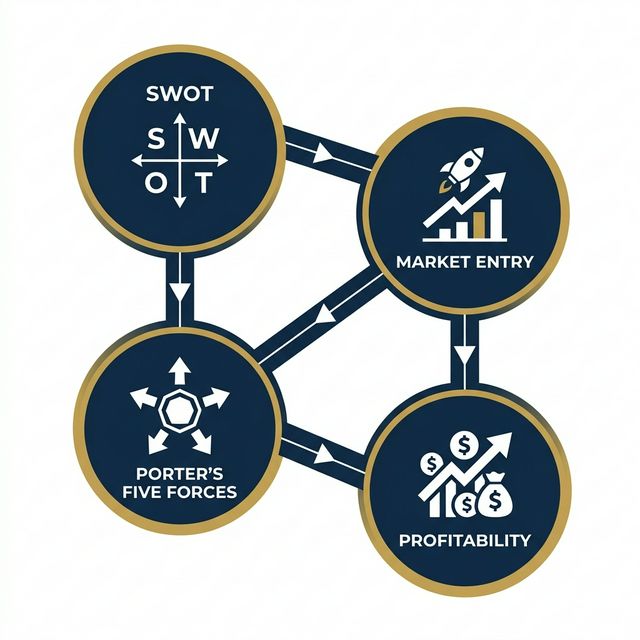
SWOT Analysis
Evaluates Strengths, Weaknesses, Opportunities, and Threats. Strengths & Weaknesses are internal; Opportunities & Threats are external (apply to all competitors).
Best for: Market EntryPorter's Five Forces
Analyses industry attractiveness: Rivalry, Threat of New Entrants, Supplier Power, Buyer Power, and Threat of Substitutes.
Best for: Industry AnalysisProfitability Framework
Revenue (Volume × Price) minus Costs (Fixed + Variable) = Profit. The most common case type: "Why are profits down?"
Best for: P&L CasesMarket Entry Framework
Diagnoses whether a company should enter a new market. Examines market attractiveness, company capability, competitive response, and financial viability.
Best for: Growth StrategyReal-World Example: SWOT — Starbucks Entering India
| Dimension | Insight |
|---|---|
| ✅ Strengths | Global brand, operational expertise, loyalty programs, premium positioning |
| ⚠️ Weaknesses | High pricing in a price-sensitive market, limited store network, unfamiliar with local tastes |
| 🚀 Opportunities | 300M+ growing middle class, rising coffee culture, rapid urbanization, young population |
| 🛑 Threats | Intense local competition (Barista, CCD) with 50% cheaper prices, strong preference for tea |
Mental Math Techniques
Mental math is non-negotiable. There is no calculator in a case interview. Shaky arithmetic kills candidate confidence. Master these three techniques and you'll handle 95% of case math.
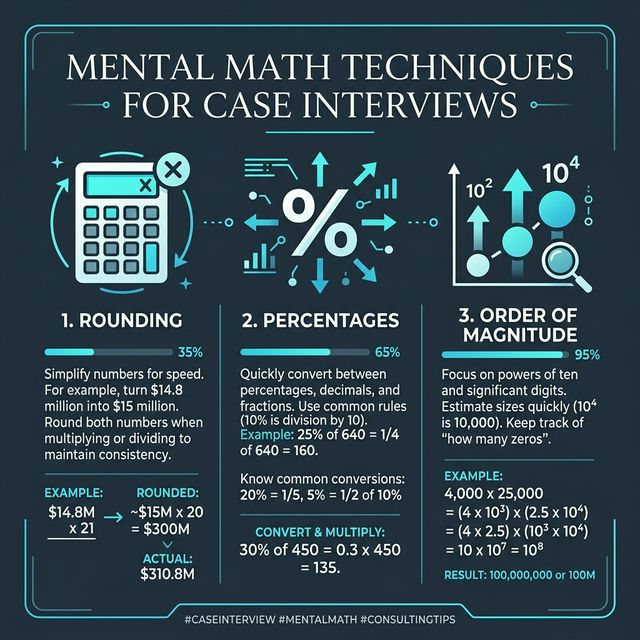
| Technique | Example | Why It Works |
|---|---|---|
| Rounding | 2,847 × 156 → 3,000 × 150 = 450,000 | Simpler numbers are faster and close enough for estimates |
| Percentages | 5% of 2M → (10% ÷ 2) = 100K | 10% is trivial (move decimal). Then halve or double as needed |
| Order of Magnitude | Market = billions = 10⁹ | Think in powers of 10 to catch errors instantly |
Real Case Example: Market Sizing
How many Starbucks stores are in the United States?
This is a classic market sizing question. Here is how to approach it step by step — the way a top candidate would in the room.
Estimate the coffee-drinking population
US population ≈ 330 million. Roughly 60% drink coffee → 200 million coffee drinkers.
Estimate Starbucks' share
40% of coffee drinkers visit Starbucks regularly → 80 million customers.
Estimate annual visits per customer
≈ 25 visits/year → 80M × 25 = 2 billion total visits/year.
Estimate capacity per store
1 store handles ≈ 100,000 visits/year → 2B ÷ 100K = ~20,000 stores.
Actual answer: ~16,000. Very close!
🎯 Sanity Check: Always validate your answer. Does 20,000 stores feel right for a country of 330 million? Yes — that's roughly one per 16,500 people. Sanity checks show interviewers you think like a consultant.
Your 4-Phase Preparation Strategy
Most candidates need 4–8 weeks and 20–30 practice cases to be interview-ready. This phased approach ensures you build skills progressively without burning out.
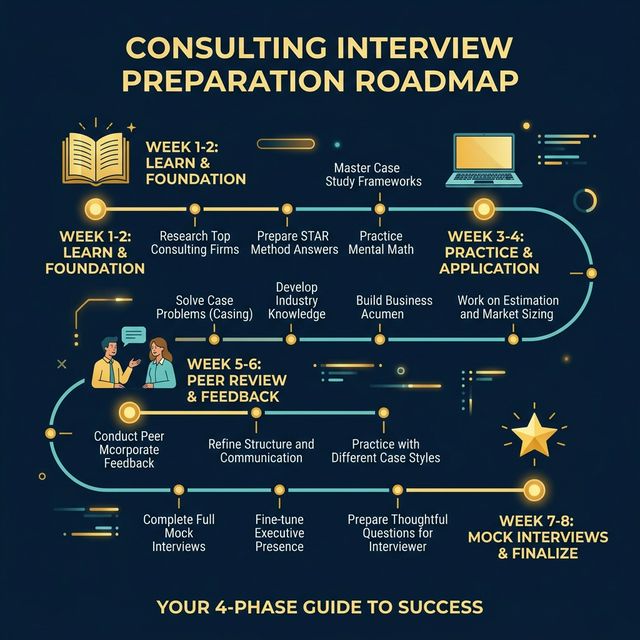
Learn the Basics
Study 3–4 core frameworks. Watch sample cases on YouTube. Read Case in Point by Marc Cosentino. Master mental math fundamentals.
Solo Practice Cases
Start with "easy" cases on PrepLounge or CaseCoach. Set 30-minute limits. Record yourself and listen for filler words. Repeat each case within 48 hours.
Peer Feedback
Find a study partner. Take turns as interviewer and candidate. Practice medium-difficulty cases. Join a case prep community for accountability.
Mock Interviews
Do 2–3 full mock interviews with an experienced coach or mentor. Simulate real pressure: 45-minute case + 15-minute feedback. Apply feedback immediately.
Common Pitfalls to Avoid
⚠️ Top Mistakes Beginners Make
- Over-relying on frameworks: Frameworks are tools, not formulas. Real cases are messy — adapt to the specifics.
- Jumping to answers too fast: Spend at least 2–3 minutes structuring before diving in. Premature analysis looks sloppy.
- Not asking clarifying questions: Treating the prompt as fully defined is a rookie error. Always probe.
- Insufficient practice: Most candidates need a minimum of 20 cases. Attempting fewer is the #1 reason for rejection.
- Neglecting feedback: Recording yourself is useless if you don't listen and correct. Feedback is fuel.
- Skipping sanity checks: Always validate your estimates against reality. Does the number feel right?
Finding Study Partners & Support
Practicing alone has real limits. You need external feedback to identify blind spots. Here are the best ways to find support:
| Resource | Best For | Cost |
|---|---|---|
| PrepLounge | Peer cases, community, structured feedback | Free / Premium |
| CaseCoach / Mentr | Connecting with coaches and industry mentors | Paid |
| LinkedIn Alumni Networks | One-off cases with consulting firm alumni | Free |
| University Consulting Clubs | Structured peer practice groups | Free |
| Paid Coach (ex-consultant) | Personalised feedback, final mock interviews | Paid |
A professional coach who has worked at McKinsey, BCG, or a Big 4 firm can identify weaknesses in one session that would take you weeks to discover alone. If budget allows, invest in at least one mock interview before your real one.
Conclusion
Preparing for a case interview as a beginner may seem daunting, but with dedication and the right strategies, you absolutely can excel. The formula is consistent: understand the process, learn your frameworks, practice deliberately, get real feedback, and maintain a growth mindset throughout.
Remember: every top consulting candidate started exactly where you are now. The difference between those who get offers and those who don't isn't raw intelligence — it's structured, intentional preparation.
For additional support preparing your consulting resume, LinkedIn profile, or interview answers, Elite Resumes specialises in helping consulting candidates stand out from day one.
Frequently Asked Questions
Ready to Land Your Consulting Role?
Your resume is the first impression. Let Elite Resumes craft a consulting-optimised CV that gets you to the interview room — so your case prep actually counts.
Explore Our Resume Services →